When a Place Name Keeps an Older Landscape
Place names and older landscapes can be read together: trace a name’s spellings, map context and local usage to separate a plausible clue from a guess.
Marshfield is an inviting name to meet on a street sign beside a dry playing field. Place names and older landscapes can remain connected long after a wet hollow has been drained or a wood cleared, but the name alone cannot tell you what once stood there. Its spelling may have changed, and its first meaning may be uncertain.
Give the question a little time: note the name as people use it, find earlier forms and see how it has been attached to places over time. This is less about reconstructing a vanished scene than understanding how a name travelled from one feature, perhaps a field or farm, to a settlement or street.
What does the name refer to now?
Write down the exact modern form and where you saw it: on a road sign, a village notice, a house name or a local map. Note what the name labels. A name once used for a small feature can later spread to a road, estate or whole settlement.
Keep any first interpretation as a question. A familiar-looking word might have another origin, or the name might have come from a person, an estate or a neighbouring settlement. Record local pronunciations and alternative spellings rather than tidying them into a form that supports your first guess.
How can you trace a name without turning it into a landscape story?
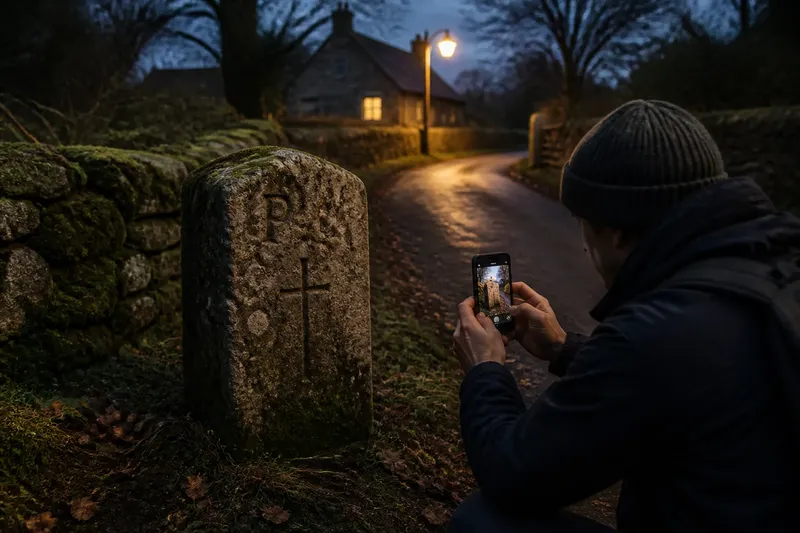
Use a notebook, pencil, current local map and a library catalogue or county archive service. For each source, record its title or description, the date you consulted it and the wording it uses. If you photograph a sign or map, note what it labels and where it is; an image separated from its context can mislead.
- Current use: Check the spelling and the feature named. If several local forms appear, record them all; if the name is consistent, use that form as your starting point.
- Earlier forms: Search a gazetteer, local history index or specialist place-name reference. If it gives dated spellings and their sources, compare them; if it offers only an unsupported explanation, treat that explanation as a lead, not a conclusion.
- Historic maps: Check a local library, archive or map collection for the name’s position. If it appears beside a field, stream or farm, note that relationship; if it does not appear, check another map before drawing a conclusion.
- Land records: Search parish histories, estate papers, directories or archive catalogues for the name in context. If a record links it to a field or farm, follow that association; if the catalogue gives only a title, inspect the item before using it as evidence.
- Present setting: If you can visit lawfully, note visible slopes, watercourses and vegetation. If a feature is visible, use it to frame a question about older records; if it is absent, do not assume it was absent in the past.
- Working note: Sort your observations into name forms, map locations, record references and present-day features. If different traces point in the same direction, describe the interpretation as plausible; if they conflict or remain thin, state what is unresolved.
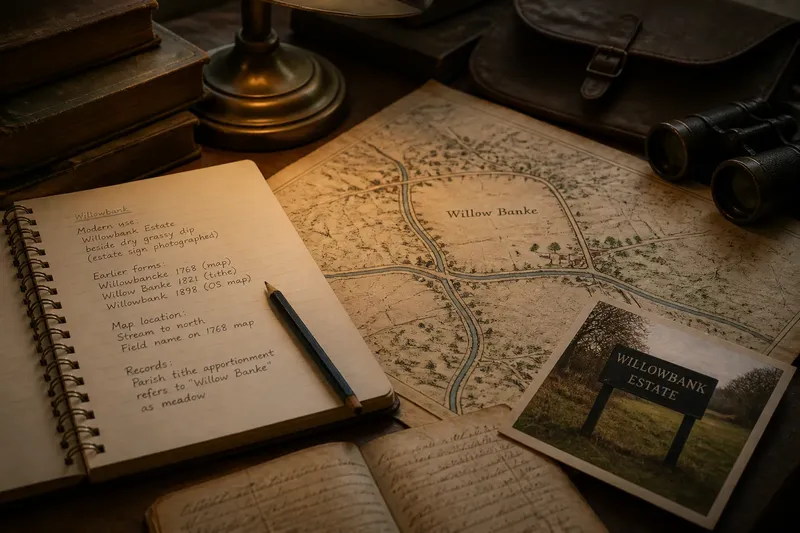
Say you are curious about the invented name Willowbank, used for a modern estate beside a dry grassy dip. You record the estate sign’s spelling, then search the local map catalogue and parish history for the dip, a nearby stream and any older name attached to either. If you find an earlier map labelling the stream but no record linking it to Willowbank, your answer is that the estate name may evoke the setting, while a historical link remains unconfirmed. That distinction is more useful than turning a suggestive name into a certain account.
Which sources can show how a name travelled?
Earlier spellings can reveal changes in sound, word boundaries or clerical habits. Compare forms as they appear in their sources instead of selecting the one that best fits a proposed meaning. A specialist reference may explain its reasoning; check whether it cites dated forms or simply repeats a local tradition.
Maps can show a name shifting from a field or farm to a road or settlement. Mapmakers chose different levels of detail and sometimes regularised spellings, so one map’s silence does not settle whether a name or feature existed. Look at the name’s position and the map’s purpose, not just whether the letters appear.
Records add another perspective. An estate inventory or parish history may place a name among references to fields, grazing or drainage. But records were made for particular purposes, and a rental list, for example, is not a complete portrait of the surrounding landscape.
The present ground can help you locate questions: a shallow dip, mature trees or damp soil may direct you towards a map or record to check. Building, planting, drainage and changes in land use can alter those features, so treat a present-day observation as context rather than proof of an older scene.
What do people ask about place names and older landscapes?
Can a place name outlast the feature it describes?
Yes. A name can remain in use after a marsh, wood, stream or field has been drained, cleared, diverted or built over. Earlier maps and records may help show what the name referred to, though they may not establish its original meaning.
Do old spellings settle a name’s meaning?
Not by themselves. A sequence of spellings can make one interpretation more plausible or expose a weak one, but handwriting, pronunciation and the habits of record-makers all affect the forms preserved.
What if a name could refer to several features?
Keep the alternatives visible and ask what would distinguish them. A map placing the name beside a stream may support one reading, while a record associating it with a farm may point elsewhere; if the evidence stays mixed, say so.
Where can I look for local place-name evidence?
Try a county archive, local studies library, historic-map collection, parish history or specialist place-name reference. Check the underlying item where possible, and note whether it provides evidence or merely repeats an explanation.
How should you describe what the evidence supports?
Keep observation and interpretation in separate sentences. “An older map places the name beside a stream” reports what a source shows. “The name may preserve a reference to water” offers a reading of that evidence.
Match the strength of the claim to the material. If early forms, map placement and local records converge, you can describe a link to a former wet area as plausible. If the modern wording is your only clue, call the connection possible but unconfirmed. Name the sources you checked and the limits of your search so another reader can understand how far the conclusion reaches.
A place name can keep a question alive even when the landscape has changed. For a search on place names and older landscapes, the most useful result may be a carefully recorded trail: the name’s forms, where each source places it and the point where evidence gives way to interpretation.